India Electric Car Sales FY2026 have officially rewritten history. India sold over 2,20,105 electric passenger vehicles between April 2025 and March 2026 nearly double the number from the year before. The Indian car buyer has spoken, and the message is loud and clear: electric is no longer the future. It is the present.
Just a couple of years ago, buying an electric car in India meant making a compromise on range, on charging options, or on budget. FY2026 changed all of that. New models arrived, prices became more competitive, charging infrastructure expanded, and buyers across the country started choosing EVs over petrol cars in record numbers.
This article covers the complete picture of electric car sales in India FY2026, which brands dominated, which models topped the charts, where in the country EVs are selling the fastest, and what the road ahead looks like.
India Electric Car Sales FY2026: The Big Picture
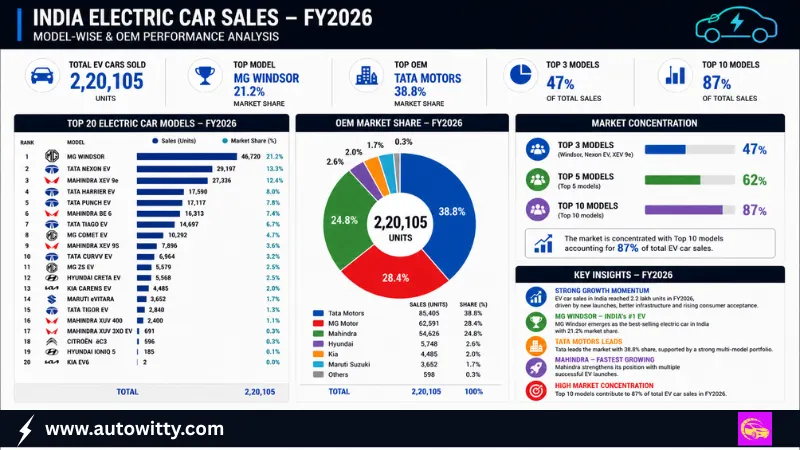
The headline number for EV sales India FY2026 is impossible to ignore. Total electric passenger vehicle dispatches crossed 2,20,105 units, while retail registration data from the VAHAN dashboard puts the figure at 1,99,923 units. Either way, the year-on-year growth stands at an extraordinary 83.6% over FY2025’s total of roughly 1,08,873 units.
Electric vehicle sales India 2026 now account for 4.5% of all passenger car registrations in the country. That may seem modest, but it was only 2.1% in FY2024-25. The EV penetration rate more than doubled in just 12 months something that took far longer in most other markets. The top 10 electric car models alone contributed nearly 87% of total EV volumes, showing how concentrated yet competitive the market has become. And with new players like Tesla India, VinFast, Maruti Suzuki, and Kia all entering or expanding in FY2026, the variety available to Indian buyers has never been greater.
India EV Market Share 2026: The Three Giants
When it comes to India EV market share 2026, the picture is dominated by three brands Tata Motors, MG Motor, and Mahindra. Together, they hold approximately 88% of all electric car sales in the country. Here is how each of them performed.
Tata Motors – Still the King (38.8% Market Share)
Tata Motors sold 85,405 electric cars in FY2026, retaining its position as India’s undisputed EV leader with a 38.8% market share. What makes Tata’s dominance special is not just the volume it is the strategy behind it. Tata offers an electric car for virtually every type of buyer in India.
Six Tata models featured in the top 20 best-selling electric cars in India: the Nexon EV, Harrier EV, Punch EV, Tiago EV, Curvv EV, and Tigor EV. Their combined sales crossed 85,000 units. No other brand comes close to this kind of portfolio depth in the Indian EV space.
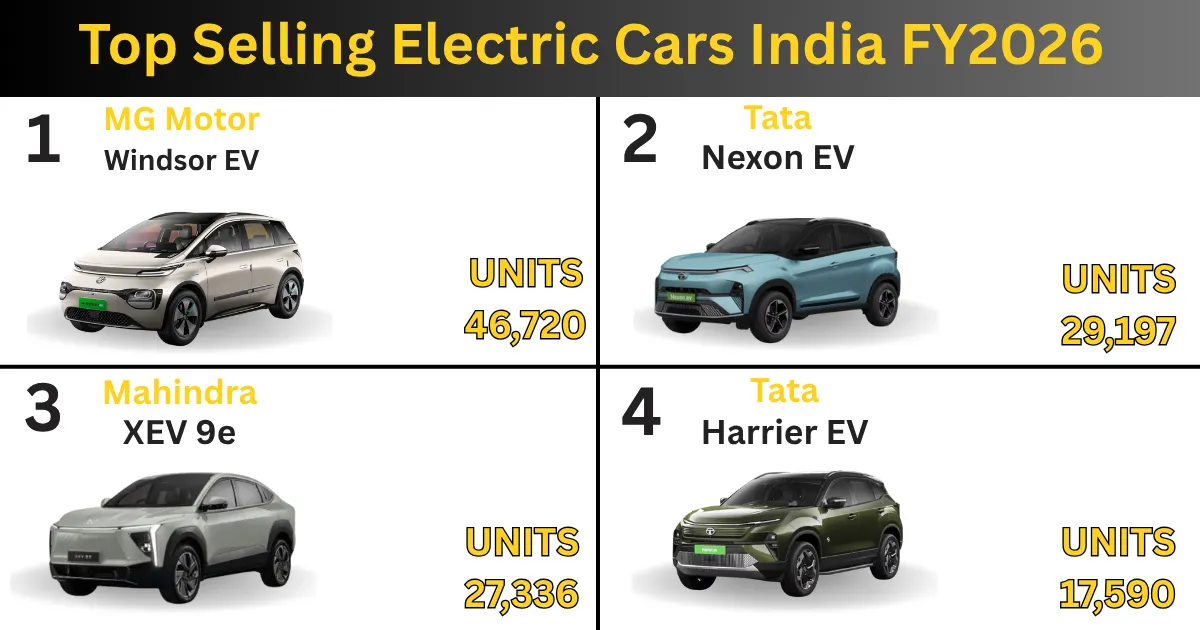
The Tata Nexon EV ranked second overall with 29,197 units, continuing its legacy as one of the most trusted mass-market electric SUVs in the country. The newly launched Harrier EV sold 17,590 units in its first full year, proving there is a strong appetite for premium electric SUVs from Indian brands. The Punch EV, positioned as an entry-level electric SUV, sold 17,117 units and became a gateway model for first-time EV buyers.
MG Motor – The 9-Out-of-10 EV Brand (28.4% Market Share)
MG Motor sold 62,591 electric cars in FY2026, claiming a 28.4% share of India’s EV market. But the real story is this: out of all the cars MG sold in India during FY2026 roughly 72,925 units a staggering 85.8% were electric. That means 9 out of every 10 cars that left an MG showroom had a charging plug.
No other mainstream car company in India — or arguably anywhere in the world at this scale — can claim that kind of EV tilt.
The Windsor EV was the engine behind this success. It became India’s no 1 best-selling electric car for eleven consecutive months and finished the year as the overall top-selling EV in India with 46,720 units more than one-fifth of the entire market on its own.
Mahindra – The Biggest Comeback Story (24.8% Market Share)
When people talk about Tata vs Mahindra EV sales in FY2026, the numbers tell a fascinating story. Tata leads in absolute volume, but Mahindra’s growth rate is the real showstopper. Mahindra sold 54,626 electric cars in FY2026, a jaw-dropping 407% increase over the approximately 8,426 units it managed in FY2025.
This transformation was driven entirely by Mahindra’s new “Born Electric” platform. The BE 6 and XEV 9e were not updated petrol cars with batteries they were designed from scratch as electric vehicles, with cutting-edge design, long range, and strong performance. The XEV 9e alone sold 27,336 units, making it the third best-selling electric car in India in FY2026. The BE 6 added another 16,313 units.
The market clearly rewarded Mahindra for investing in purpose-built EV architecture. In the Tata vs Mahindra EV sales battle, Tata still leads but Mahindra is closing the gap faster than anyone expected.
Top India Electric Car Sales FY2026– Full Model Rankings
Here is the complete model-wise leaderboard for top selling electric cars India in FY2026:
| Rank | Model | Brand | Units Sold | Market Share |
| 1 | Windsor EV | MG Motor | 46,720 | 21.2% |
| 2 | Nexon EV | Tata | 29,197 | 13.3% |
| 3 | XEV 9e | Mahindra | 27,336 | 12.4% |
| 4 | Harrier EV | Tata | 17,590 | 8.0% |
| 5 | Punch EV | Tata | 17,117 | 7.8% |
| 6 | BE 6 | Mahindra | 16,313 | 7.4% |
| 7 | Tiago EV | Tata | 14,697 | 6.7% |
| 8 | Comet EV | MG Motor | 10,292 | 4.7% |
| 9 | XEV 9S | Mahindra | 7,896 | 3.6% |
| 10 | Curvv EV | Tata | 6,964 | 3.2% |
| 11 | ZS EV | MG Motor | 5,579 | 2.5% |
| 12 | Creta Electric | Hyundai | 5,563 | 2.5% |
| 13 | Carens Clavis EV | Kia | 4,483 | 2.0% |
| 14 | eVitara | Maruti Suzuki | 3,652 | 1.7% |
| 15 | Tigor EV | Tata | 2,840 | 1.3% |
| 16 | XUV 400 | Mahindra | 2,400 | 1.1% |
| 17 | XUV 3XO EV | Mahindra | 681 | 0.3% |
| 18 | ë-C3 | Citroën | 598 | 0.3% |
| 19 | IONIQ 5 | Hyundai | 185 | 0.1% |
| 20 | EV9 | Kia | 2 | 0.0% |
| Total | 2,20,105 | 100% |
The top three models Windsor EV, Nexon EV, and XEV 9e together accounted for nearly 47% of all electric vehicle sales India FY2026. That is almost half the market controlled by just three models.
ALSO READ: Kia India February 2026 Sales Hit Record 27,610 Units With 10.3% Growth
Where Is Electric Vehicle Sales India 2026 Happening?
Electric vehicle sales India 2026 are not spread evenly across the country. The top 10 states account for over 83% of all EV registrations, and a handful of states are driving the bulk of the volume.
Maharashtra led in absolute numbers with 34,066 units, followed by Karnataka (24,201 units) and Kerala (20,226 units). These three states alone contributed over 35% of India’s total electric car sales in FY2026.
In terms of EV penetration meaning how many of the cars sold in a state are electric Telangana ranked first at an impressive 11.6%, followed by Chandigarh (9.1%) and Delhi (8.4%). Kerala was close behind at 7.9%.
States with strong EV policies, road tax exemptions, and urban charging infrastructure are clearly seeing faster adoption. For electric car sales in India to grow beyond the metros, charging access in Tier-2 and Tier-3 cities will need to catch up.
Why Did Electric Car Sales in India FY2026 Almost Double?
Several forces came together to create this extraordinary growth in EV sales India FY2026:
1. A flood of exciting new models From Mahindra’s Born Electric SUVs to the Tata Harrier EV, Maruti eVitara, Kia Carens Clavis EV, and the entry of Tesla and VinFast, FY2026 had the most diverse EV launch calendar India has ever seen.
2. Better battery warranties The industry standard settled at 8 years / 1,60,000 km. Tata even offers a lifetime high-voltage battery warranty on select Punch EV variants. This gave buyers the confidence they needed.
3. Smarter ownership models MG’s Battery-as-a-Service (BaaS) option on the Windsor EV brought down the upfront price significantly, pulling in buyers who were previously priced out.
4. Lower running costs With petrol prices staying high, the cost-per-kilometre advantage of EVs became a very practical reason to switch, especially for high-mileage urban commuters.
5. State government incentives Delhi, Maharashtra, Tamil Nadu, and Karnataka offer 15–25% on-road price advantages through road tax waivers and EV subsidies. These incentives made a real difference in purchase decisions.
6. Growing charging infrastructure Highway charging corridors expanded, and workplace and residential charging became more common, reducing the range anxiety that held back many potential buyers.
ALSO READ: Top 7 Highest Selling Car Brands in India February 2026, Full Sales Report
Emerging Players Worth Watching
Beyond the big three, a few newer entrants are worth keeping an eye on as India’s EV market matures.
Hyundai finished fourth in India EV market share 2026 with 5,748 units, powered almost entirely by the Creta Electric. The Creta’s trusted name and strong value proposition made it an easy choice for buyers looking beyond the top three brands.
Kia was the fastest-growing EV brand in India in FY2026 percentage-wise jumping nearly 794% year-on-year to 4,485 units. The Carens Clavis EV launched in 2025 was the catalyst, and the upcoming Syros EV is expected to add further momentum in FY2027.
Maruti Suzuki made its EV debut with the eVitara, selling a respectable 3,652 units in its launch year. For a brand that dominates India’s petrol car market, this is just the beginning. More affordable Maruti EVs are already in the pipeline.Luxury EVs also hit a record high of 5,404 units in FY2026 led by BMW, Mercedes-Benz, Audi, and Volvo. Premium EV demand grew 85% year-on-year.
What to Expect from India’s EV Market in FY2027
The momentum built in FY2026 sets a strong foundation, but the next chapter will require fresh drivers of growth.
The affordable EV gap specifically the sub-₹10 lakh segment remains largely unfilled. Maruti’s upcoming electric hatchback and MPV could change that significantly. Tata’s continued presence at the entry end also helps.
New model launches already confirmed or expected include the Kia Syros EV, Hyundai’s made-in-India compact EV, BYD’s expanding CBU range, Honda’s 0 α electric SUV, and more Mahindra variants built on its BE platform.
Infrastructure investment will need to keep pace. India currently has around 25,000 public EV charging stations a number that needs to grow several times over to support a market heading towards 5 lakh annual EV sales.
India Electric Car Sales FY2026 Final Verdict:
Electric car sales in India FY2026 told a three-part story.
Tata Motors held the crown with the broadest portfolio and the most consistent performance across price segments. MG Motor disrupted the market with the Windsor EV and proved that a focused, tech-first approach can grab nearly 30% market share. Mahindra staged the most dramatic turnaround, with sales jumping over 400% and two models landing in the top six.
But the bigger winner is the Indian consumer. With more choices, better technology, stronger warranties, and smarter pricing than ever before, buying an electric car in India has never made more sense. And if FY2026 is any indication, the best is very much still to come.
India Electric Car Sales FY2026 FAQs
What are India Electric Car Sales FY2026 figures?
India electric car sales FY2026 crossed 2.2 lakh units, marking an impressive 83% year-on-year growth and showing strong EV adoption across the country.
Which is the best-selling EV in India FY2026?
The MG Windsor EV emerged as the top-selling electric car, leading the market with the highest annual sales.
Which company leads EV sales in India?
Tata Motors leads, followed by MG Motor and Mahindra.
Why are EV sales increasing in India?
Better infrastructure, new launches, and lower running costs.
Is 2026 a good time to buy an EV?
Yes, especially for city usage with access to charging.