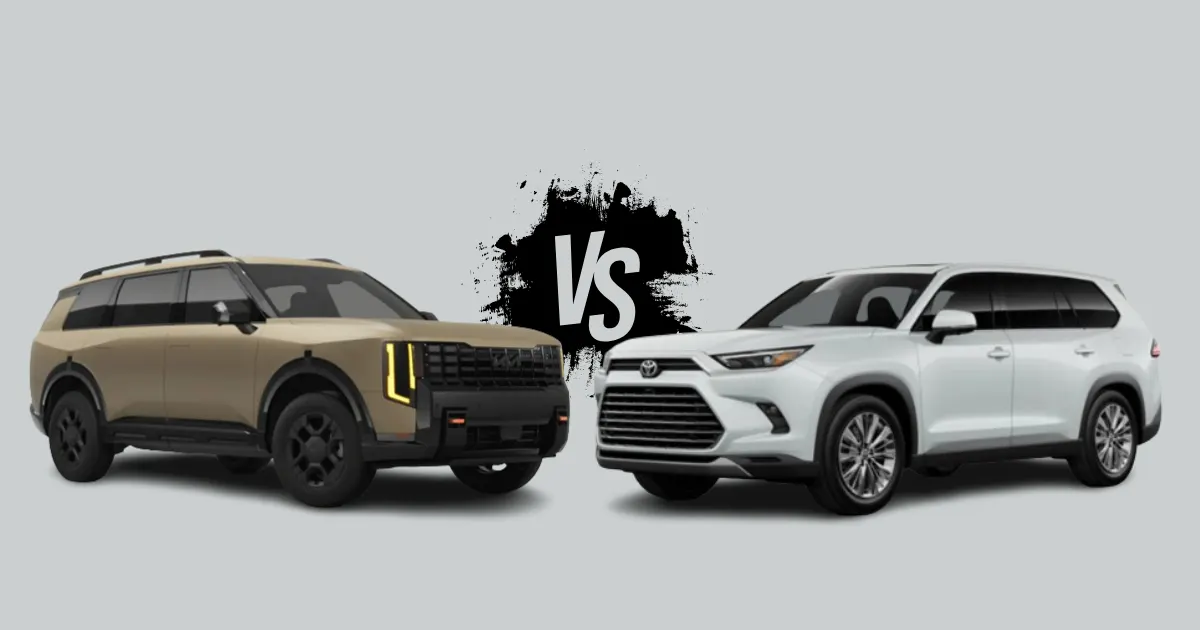
Choosing between Toyota vs Kia is no longer as simple as picking the brand with the stronger reputation. Both automakers offer affordable cars, practical SUVs, advanced technology and increasingly competitive electric vehicles. However, the two brands follow very different philosophies.
Toyota continues to focus heavily on reliability, long-term ownership and strong resale value, while Kia has built its recent success around bold styling, modern technology, generous equipment and attractive warranty coverage.
For buyers trying to decide between the two, this Toyota vs Kia comparison highlights five important differences that could make one brand a better fit.
1. Toyota Still Has the Reliability Advantage
Reliability remains one of Toyota’s biggest strengths. Kia, however, has made significant progress and is now much closer to Toyota than it was in the past.
According to the supplied Consumer Reports and J.D. Power rankings, Toyota remains ahead in predicted reliability and long-term dependability. Toyota ranked 1st out of 26 brands in the Consumer Reports data provided, compared with Kia’s 10th position. In J.D. Power’s Vehicle Dependability Study, Toyota ranked 8th out of 28, while Kia came 9th.
Interestingly, the picture changes when looking at initial quality. Kia ranked 11th out of 27 brands in J.D. Power’s Initial Quality Study, ahead of Toyota at 15th. That makes the Toyota vs Kia reliability gap much smaller than many buyers might expect.
| Reliability Measure | Kia | Toyota | Advantage |
|---|---|---|---|
| Consumer Reports | 10th/26 | 1st/26 | Toyota |
| J.D. Power Vehicle Dependability | 9th/28 | 8th/28 | Toyota |
| J.D. Power Initial Quality | 11th/27 | 15th/27 | Kia |
Toyota also has proven models such as the Camry, which has built a strong reputation for durability. At the same time, Kia has several competitive products where it can match or even beat Toyota, particularly in some SUV categories.
Verdict: Toyota still wins on overall reliability, but the gap has narrowed enough that reliability alone may not be a decisive reason to reject Kia.
2. Kia Offers a Much Stronger Standard Warranty
This is one area where Kia has a clear advantage.
Kia’s standard warranty package is considerably more generous than Toyota’s basic and powertrain coverage. The difference becomes especially important for buyers planning to keep their vehicle for many years.
| Warranty | Kia | Toyota |
|---|---|---|
| Basic Warranty | 5 years/60,000 miles | 3 years/36,000 miles |
| Powertrain | 10 years/100,000 miles | 5 years/60,000 miles |
| Anti-Perforation | 5 years/100,000 miles | 5 years/unlimited miles |
| EV Battery | 10 years/100,000 miles | 10 years/150,000 miles |
Toyota does have an advantage for EV battery coverage, offering an additional 50,000 miles based on the supplied figures. Its anti-perforation warranty also has unlimited mileage.
Toyota further sweetens ownership with two years or 25,000 miles of complimentary scheduled maintenance, something Kia does not provide in the same way.
Still, Kia’s 10-year/100,000-mile powertrain warranty is a major attraction and gives buyers additional confidence.
Verdict: Kia is the clear winner for basic and powertrain warranty coverage, while Toyota has some advantages in maintenance and specific warranty areas.
For buyers comparing Toyota vs Kia, warranty coverage can become an important factor in the final decision.
ALSO READ: Kinetic DX+ 3.1 kWh Launched at Rs. 1.27 Lakh With 132 km Range
3. Toyota Cars Hold Their Value Better
If you’re thinking about resale value before buying a new car, Toyota has a major advantage.
Toyota’s reputation for durability, dependable engineering and long vehicle lifecycles has helped its cars retain their value exceptionally well. According to the supplied CarEdge data, Toyota vehicles retain around 64.9% of their value after five years, compared with 51.4% for Kia.
| Brand | Average 5-Year Resale Value | Mainstream Brand Ranking |
|---|---|---|
| Toyota | 64.9% | 1st |
| Kia | 51.4% | 11th |
This difference can have a meaningful effect on the total cost of ownership. A Toyota may cost more initially in some comparisons, but its stronger resale value can help recover more money when you eventually sell it.
Kia’s lower resale value can work in the opposite direction. For used-car shoppers, that depreciation can actually become an advantage because a used Kia may be available at a more attractive price than an equivalent Toyota.
Verdict: Toyota is the stronger choice if resale value is one of your top priorities. Kia can make more sense for buyers looking for a better-value used vehicle.
4. Kia Generally Offers More Technology and Features
This is where Kia has successfully differentiated itself.
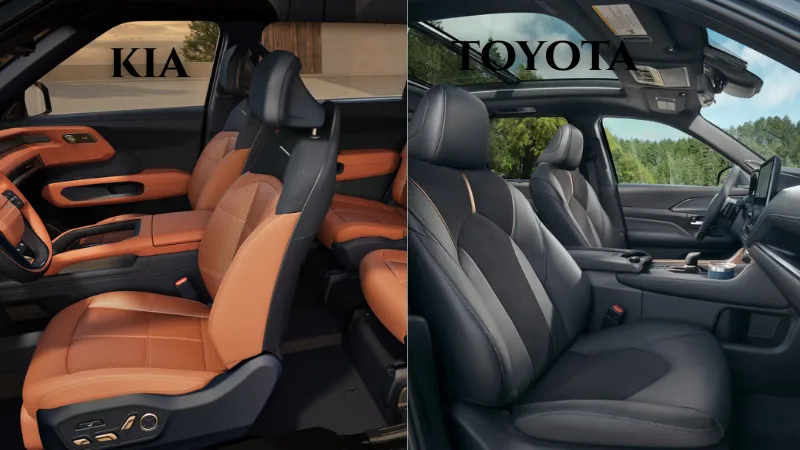
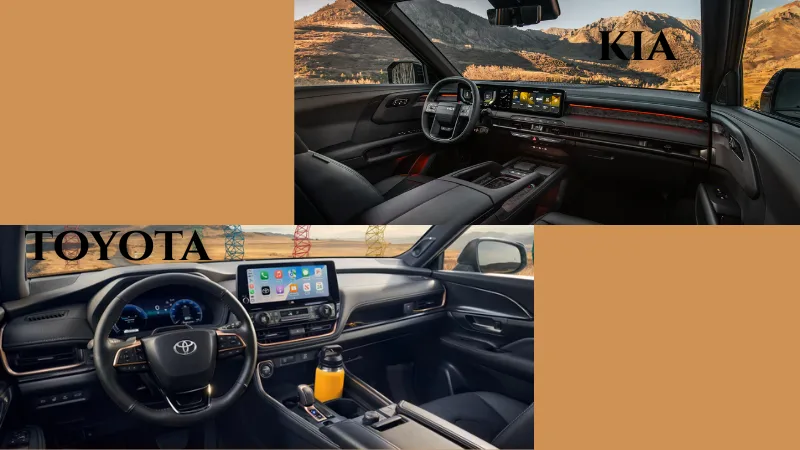
Modern Kia vehicles often focus heavily on technology, cabin design and standard equipment. Models such as the Telluride demonstrate how Kia can deliver a premium-looking interior without moving too far into luxury-car pricing.
Toyota’s Grand Highlander is also a highly capable family SUV, but Kia’s approach often feels more feature-rich for the money.
Consider the supplied comparison between the Kia Telluride S and Toyota Grand Highlander LE:
In this part of the Toyota vs Kia comparison, Kia has a clear advantage for feature-focused buyers.
| Feature | Kia Telluride S | Toyota Grand Highlander LE |
|---|---|---|
| Engine | 2.5L turbo, 274 hp | 2.4L turbo, 265 hp |
| Wheels | 20-inch alloys | 18-inch alloys |
| Power Sunroof | Yes | No |
| Heated Front Seats | Yes | No |
| Driver’s Power Seat | Yes | Yes |
| Tri-Zone Climate | Yes | Yes |
| Touchscreen | 12.3-inch | 12.3-inch |
| Speakers | 8 | 6 |
| Power Liftgate | Yes | Yes |
ALSO READ: Kia September 2026 Discounts: Benefits Up To ₹1.70 Lakh
The Telluride S therefore offers several desirable features while remaining competitively priced.
The same philosophy can be seen across Kia’s range. The brand tends to emphasize attractive interiors, large displays, connected technology and modern design, while Toyota often takes a more conservative approach.
Verdict: If you want maximum features, modern design and technology for your money, Kia is generally the more appealing option.
5. Toyota vs Kia Offer Different Choices
Another important difference is the type of vehicles each manufacturer offers.
Toyota has one of the broadest lineups, covering everything from compact cars to large SUVs, pickups, hybrids and performance vehicles. It also has a strong presence in off-road-oriented models.
Kia, however, has entered several categories where Toyota doesn’t currently offer a direct equivalent.
Kia’s Unique Advantages
- EV9 electric three-row SUV
- Sorento three-row SUV positioned below $35,000
- EV3 sub-$35,000 EV
- Carnival non-hybrid minivan
Toyota’s Unique Advantages
- GR86 and GR Supra sports cars
- Tacoma and Tundra pickup trucks
- Crown large sedan
- Camry hybrid midsize sedan
- Prius hybrid hatchback
- Land Cruiser and other off-road-focused models
- TRD variants of several SUVs and trucks
This means the better brand can depend heavily on what type of vehicle you actually want.
For example, someone searching for a three-row electric SUV may find Kia’s EV9 particularly compelling. A buyer looking for a midsize pickup, meanwhile, has Toyota’s Tacoma as an obvious option.
Toyota vs Kia: Which Brand Should You Buy?
There isn’t one universal winner in the Toyota vs Kia battle because both brands target slightly different priorities.
Toyota remains the safer choice for buyers who prioritize long-term reliability, resale value and a broad vehicle lineup. Its conservative approach has helped the company maintain a strong reputation among customers.
Kia, meanwhile, is the more exciting choice for buyers who want modern styling, more standard features, competitive pricing and a class-leading warranty package.
Pros and Cons of Toyota vs Kia
Toyota Pros
- Excellent long-term reputation
- Strong resale values
- Broad model range
- Strong hybrid lineup
- Good complimentary maintenance package
Toyota Cons
- Warranty coverage is less generous
- Some models can feel less feature-rich
- New-car pricing can be higher than comparable Kia models
Kia Pros
- Longer basic and powertrain warranties
- Attractive and modern designs
- Lots of standard technology
- Competitive pricing
- Strong range of SUVs and EVs
Kia Cons
- Lower average resale values
- Overall reliability reputation still trails Toyota
- Lineup is not as broad in certain segments
Final Verdict
The Toyota vs Kia decision ultimately comes down to what matters most to you as a buyer.
Choose Toyota if your priorities are reliability, resale value, long-term ownership and a wide selection of vehicles. Choose Kia if you want a stylish vehicle packed with features, a competitive purchase price and substantially stronger basic and powertrain warranty coverage.
Kia’s recent progress has made this comparison much closer than it once was. Toyota still holds important advantages, but Kia has become a serious alternative for buyers who don’t want to pay extra simply for a familiar badge.
For many shoppers, the smartest approach is not to choose a brand first. Instead, shortlist the specific Toyota and Kia models that fit your budget, compare their equipment and ownership costs, and then make the final decision.
Frequently Asked Questions of Toyota vs Kia
Q1. Is Toyota more reliable than Kia?
A: Overall, Toyota still has the reliability advantage based on the supplied Consumer Reports and J.D. Power rankings. However, Kia has improved significantly and performs strongly in some individual vehicle segments.
Q2. Which brand has a better warranty, Toyota vs Kia?
A: Kia has the stronger basic and powertrain warranty. Its coverage extends to 5 years/60,000 miles for the basic warranty and 10 years/100,000 miles for the powertrain.
Q3. Which has better resale value, Toyota vs Kia?
A: Toyota has a significant advantage in resale value. The supplied CarEdge figures show Toyota retaining about 64.9% of its value after five years versus 51.4% for Kia.
Q4. Are Kia cars better equipped than Toyota cars?
A: In many comparable models, Kia offers more standard technology and comfort features for the money. However, equipment varies by model and trim, so buyers should compare specific versions.
Q5. Should I buy a Kia vs Toyota for long-term ownership?
A: Toyota is generally the stronger choice if long-term reliability and resale value are your biggest priorities. Kia can be attractive if warranty coverage, features and initial value are more important.
Q6. Which brand has a wider vehicle lineup?
A: Toyota has the broader overall lineup, including sports cars, pickup trucks, hybrids and off-road-focused vehicles. Kia has fewer categories but offers distinctive models such as the EV9 and Carnival.