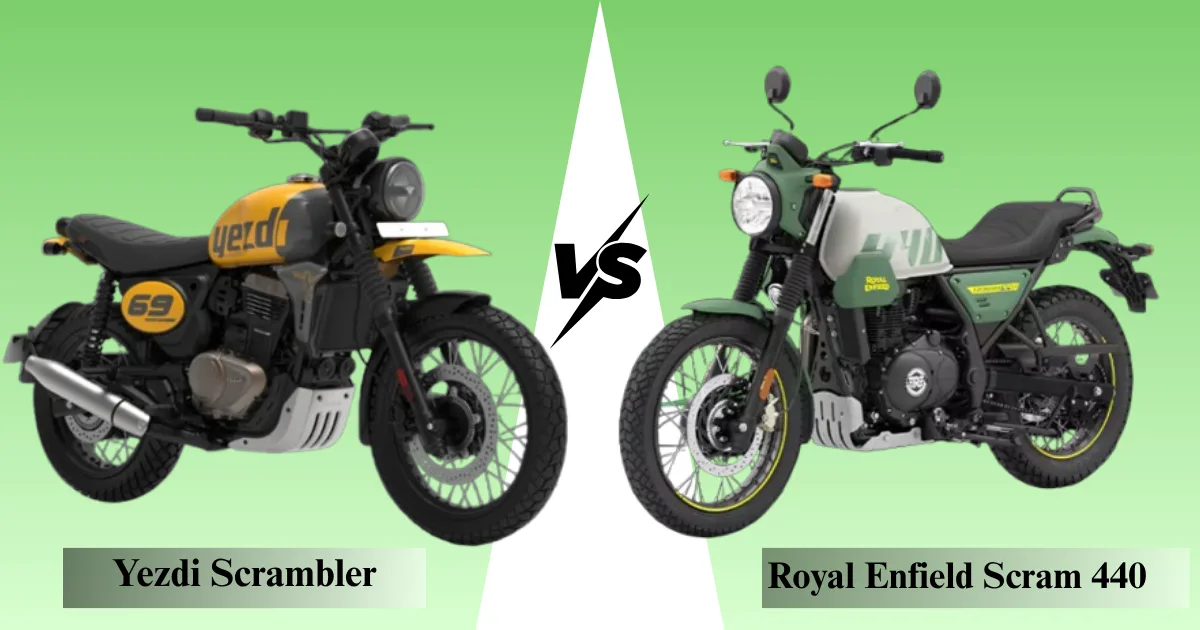
The entry-level scrambler segment in India is evolving quickly, and two motorcycles that currently define this space are the Yezdi Scrambler and the Royal Enfield Scram 440. Both aim to offer a balance between everyday usability and light off-road ability, but they approach this idea in very different ways. In this detailed Yezdi Scrambler vs Royal Enfield Scram 440 comparison, the differences are not just limited to specifications but extend to how each motorcycle behaves in real-world riding conditions.
Pricing differences
Pricing is often the first deciding factor, and here the gap is quite clear. The Yezdi Scrambler starts at ₹2 lakh and goes up to ₹2.09 lakh, making it the more affordable entry point into the scrambler category. Meanwhile, the Royal Enfield Scram 440 is priced between ₹2.23 lakh and ₹2.31 lakh, which reflects not only its mechanical differences but also the strong brand positioning of Royal Enfield in India.
However, what is important to understand is that the price variation in both motorcycles is largely cosmetic. In the case of the Scram 440, the base variant uses spoke wheels with tube-type tyres, which are generally better for off-road durability but require more maintenance. Higher variants offer alloy wheels with tubeless tyres, which are more convenient for daily commuting. This small detail plays a significant role in usability but is often overlooked in basic comparisons.
Engine and performance
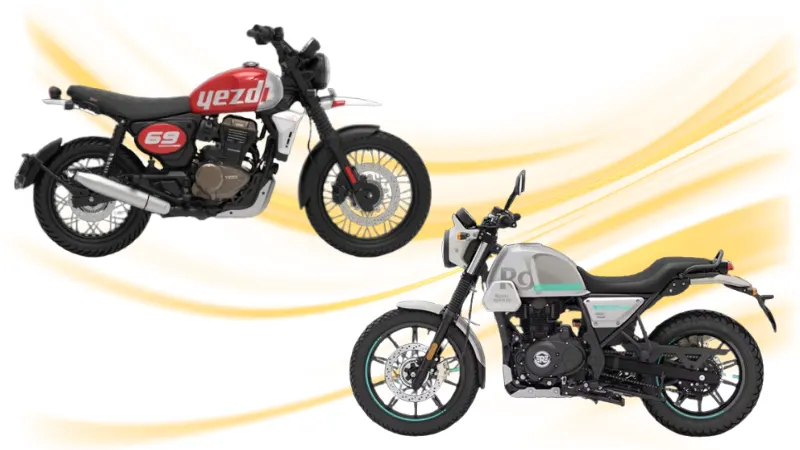
The engine characteristics highlight the biggest philosophical difference in the Yezdi Scrambler vs Royal Enfield Scram 440 matchup. The Yezdi Scrambler is powered by a 334cc liquid-cooled, single-cylinder engine that delivers 30 bhp and 30 Nm of torque. This setup feels more modern and rev-happy, delivering stronger performance at higher RPMs. Riders who enjoy quick acceleration and highway bursts will find this engine more engaging.
On the other hand, the Royal Enfield Scram 440 features a larger 443cc air-cooled engine producing 25.7 bhp and 34 Nm. The focus here is clearly on torque delivery at lower RPMs. This makes the bike extremely easy to ride in city conditions, as it requires fewer gear shifts and feels less stressed even at low speeds.
In real-world conditions, the Yezdi feels quicker, while the Scram 440 feels stronger and more relaxed. Both motorcycles use a 6-speed gearbox, but their riding personalities are completely different.
ALSO READ: 2026 Yezdi Scrambler Launched in India Today – Price, Specs And Key Updates
Size, weight and road presence
When comparing dimensions, it is important to understand how manufacturers quote weight. Yezdi lists a wet weight of 174 kg without fuel, while Royal Enfield provides a kerb weight of 196 kg, which includes fuel. This means the actual difference is smaller than it appears on paper, but the Scram 440 is still noticeably heavier in real-world riding.
Seat height is another crucial factor. The Yezdi’s 813 mm seat height may feel slightly tall for shorter riders, whereas the Scram 440’s 795 mm setup is more accessible and confidence-inspiring in traffic. The longer wheelbase of the Scram adds stability at higher speeds, while the shorter wheelbase of the Yezdi improves maneuverability.
Fuel tank capacity also plays a practical role. The Scram 440’s 15-litre tank gives it a clear advantage for long-distance touring, while the Yezdi’s 12.5-litre tank is more suited for city and short highway runs.
Yezdi Scrambler vs Royal Enfield Scram 440: Hardware and features
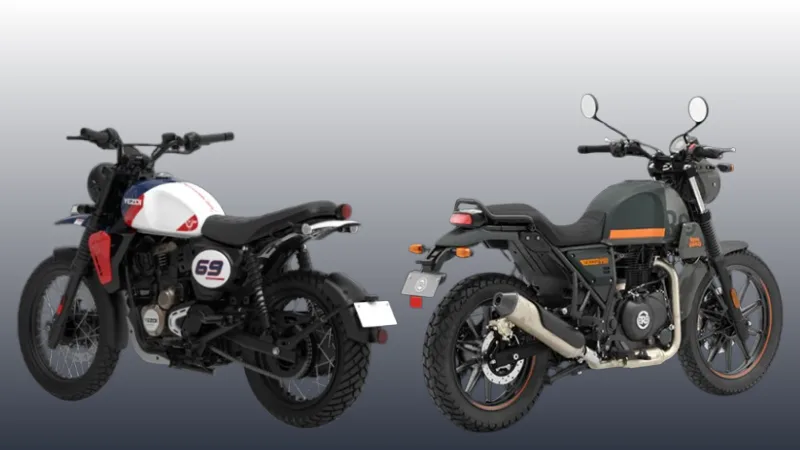
On the hardware side, both motorcycles share similar fundamentals but differ in execution. Both use a 19-inch front wheel, which is ideal for handling rough roads. However, the rear tyre size makes a noticeable difference. The Yezdi uses a wider 140-section tyre, which provides better grip and confidence while cornering on tarmac. In comparison, the Scram 440 uses a 120-section tyre, which slightly reduces grip but improves off-road flexibility.
Braking performance is another area where Yezdi has a slight advantage on paper, thanks to its larger 320 mm front disc compared to the 300 mm unit on the Scram 440. In practical terms, this may translate into sharper braking feel, especially during aggressive riding.
Suspension setup is where the Scram 440 pulls ahead. Its monoshock with longer travel absorbs bumps more effectively, making it better suited for broken Indian roads and mild off-road trails. The Yezdi’s twin shock setup is simpler and works well on smooth roads but feels slightly firmer over rough surfaces.
Feature-wise, both bikes keep things minimal. The Yezdi’s fully digital LCD display offers a modern look, while the Scram’s digital-analogue cluster adds a classic touch. Neither bike offers Bluetooth connectivity, which might feel like a miss for tech-savvy riders.
ALSO READ: Royal Enfield Scram 440 Price in India, Colours, Bold Looks
Riding experience and practicality
The biggest difference becomes clear when both bikes are ridden back to back. The Yezdi Scrambler feels light, responsive, and quick, making it enjoyable for riders who prefer a more engaging ride. It is particularly suited for city riding and occasional spirited highway runs.
The Scram 440, on the other hand, delivers a more relaxed and comfortable experience. Its torque-heavy engine allows effortless riding, especially in traffic. On highways, it feels stable and less stressed, making it ideal for long-distance touring.
Over rough roads, the Scram’s suspension setup and overall build give it an edge. It feels more composed and capable when the terrain gets challenging, whereas the Yezdi is more road-focused in comparison.
Ownership Experience and Brand Factor
Ownership experience is where the Yezdi Scrambler vs Royal Enfield Scram 440 comparison becomes more one-sided. Royal Enfield has a well-established presence in India, supported by a wide service network, strong resale value, and proven reliability. For long-term ownership, factors like spare parts availability and service accessibility play a major role, and Royal Enfield clearly has an advantage here.
In contrast, Yezdi is still rebuilding its position in the market. While the brand has made noticeable improvements, its service network and long-term ownership perception are still evolving. In metro cities, the experience is generally better, but in smaller towns, the difference can be more noticeable.
For buyers looking for peace of mind and hassle-free ownership, the Scram 440 is the safer choice. However, those who prioritize performance and a slightly more unique product may still find the Yezdi Scrambler appealing.
Pros and Cons
Yezdi Scrambler
Pros:
- More powerful engine
- Lighter and more agile
- Lower price
Cons:
- Smaller fuel tank
- Less brand trust compared to RE
Royal Enfield Scram 440
Pros:
- Strong low-end torque
- Better touring capability
- Superior brand value
Cons:
- Heavier
- Less powerful on paper
- Slightly expensive
Final Verdict
The Yezdi Scrambler vs Royal Enfield Scram 440 comparison ultimately comes down to rider preference. If you are looking for a motorcycle that feels quick, modern, and fun to ride, the Yezdi Scrambler is the better choice. It offers strong performance and better value for money.
However, if your priority is comfort, stability, and a relaxed riding experience, the Royal Enfield Scram 440 stands out. It may cost more, but it delivers a sense of confidence and durability that many riders appreciate.
In simple terms, the Yezdi is for those who want excitement, while the Scram 440 is for those who want ease and reliability.
Frequently Asked Questions
1. Which bike is better for city riding?
A: The Yezdi Scrambler feels more agile in city conditions, while the Scram 440 offers easier riding due to its strong torque.
2. Which motorcycle is better for long-distance touring?
A: The Royal Enfield Scram 440 is better suited for touring thanks to its larger fuel tank, stable ride, and relaxed engine character.
3. Does the Yezdi Scrambler offer better performance?
A: Yes, the Yezdi Scrambler produces higher power and feels quicker, especially at higher speeds.
4. Which bike is more beginner-friendly?
A: The Scram 440 is more beginner-friendly due to its smooth torque delivery and lower seat height.
5. Which bike is better for off-road riding?
A: The Royal Enfield Scram 440 performs better off-road due to its longer suspension travel and more stable setup.