The Mitsubishi Pajero is making a comeback, and this time it is returning with a much more serious ambition. Instead of being positioned simply as another premium SUV, the all-new Pajero arrives as Mitsubishi’s global flagship cross-country SUV, bringing together a ladder-frame chassis, diesel power, full-time four-wheel-drive hardware while offering the versatility to handle everyday highways as well as demanding off-road trails.
The new-generation model also marks a major change in positioning for the legendary Pajero nameplate. Mitsubishi has given the SUV a more premium cabin, three-row seating and a long list of modern safety and connectivity features. At the same time, the company has retained the rugged mechanical character that made the Pajero famous among off-road enthusiasts.
With a 4,920 mm-long body, seven seats, a 2.4-litre diesel engine and Mitsubishi’s Super-All Wheel Control system, the new Pajero is clearly targeting established premium off-roaders such as the Toyota Land Cruiser 250 Series.
New Mitsubishi Pajero: Exterior Design
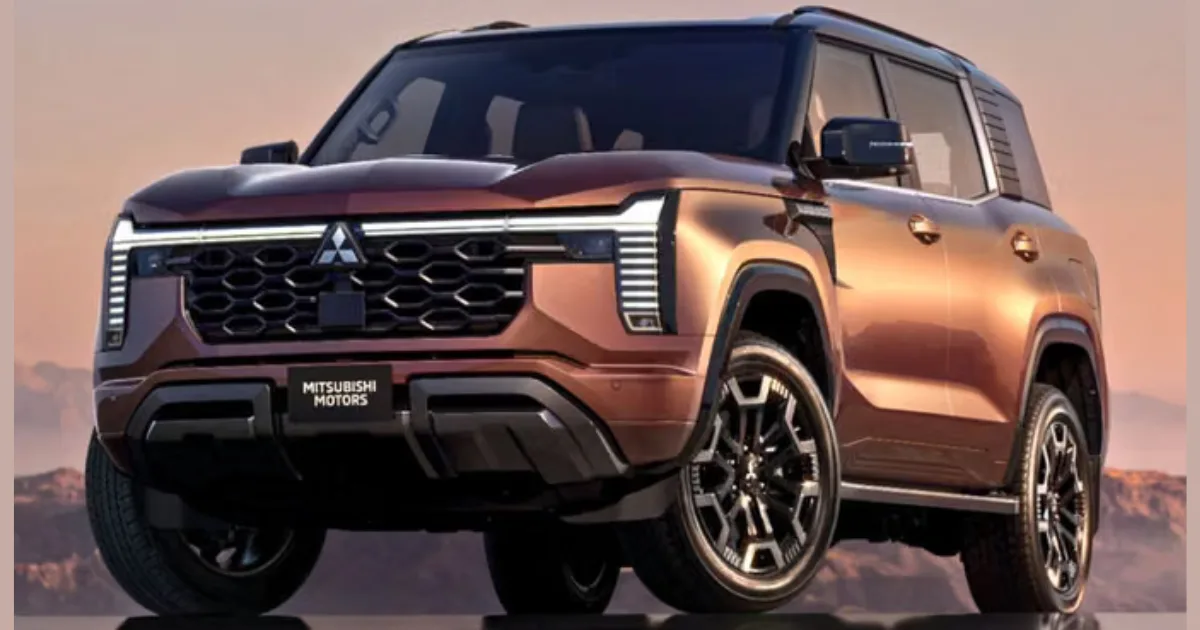
The new Pajero adopts a completely modern design while retaining the upright proportions expected from a serious off-road SUV. At 4,920 mm long, it has the road presence required to compete with larger body-on-frame SUVs.
At the front, the SUV gets distinctive T-shaped LED lighting, giving it a recognizable identity. The upright nose is complemented by a tough-looking bumper and substantial skid plates that visually reinforce its adventure-focused character.
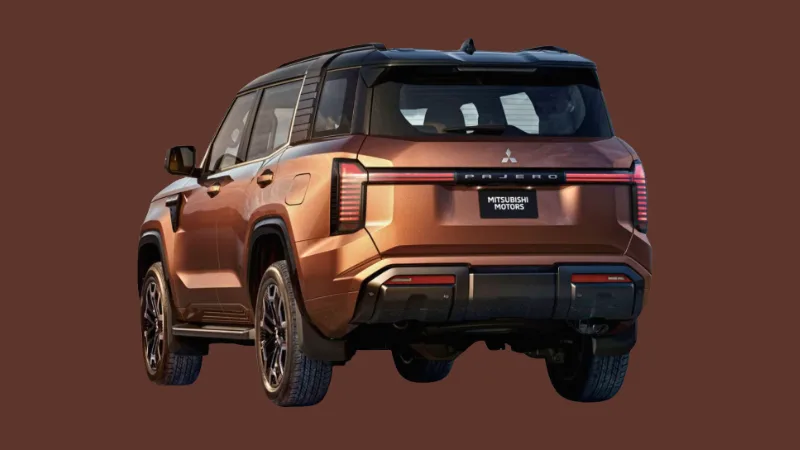
The sides feature squared-off wheel arches and prominent body surfacing. Mitsubishi has also added side gills carrying Pajero lettering, while the textured C-pillar creates a distinctive visual connection between the roof and rear section.
At the rear, the sculpted tailgate gives the SUV a more premium appearance without making it look overly soft.
Among the available colours, Armor Copper Metallic stands out for its rugged premium appearance. Mitsubishi is also introducing a new Phantom Blue Metallic shade with gold accents, giving buyers a more distinctive alternative.
Premium Three-Row Cabin with Seven-Seat Practicality
Inside, the new Pajero moves considerably further upmarket than its predecessors. The SUV offers three rows and seating for seven passengers, with the long 2,870 mm wheelbase helping create a practical cabin layout.
Mitsubishi has focused on improving the perceived quality of the interior through soft-touch materials and better detailing. Buyers looking for a more luxurious ambience can opt for Camel-coloured leather upholstery with black inserts and fine stitching.
The dashboard is dominated by a large digital display setup. Higher variants feature dual 14.3-inch screens integrated into a single panel, while lower trims use a 12.3-inch display.
One of the most interesting details is the digital Multi Meter display. It pays tribute to the triple-gauge instrument arrangement found in older Pajero generations while adding modern functionality.
Instead of simply displaying conventional driving information, the Multi Meter can provide off-road data such as:
- Altitude
- Compass heading
- Outside temperature
- Pitch angle
- Roll angle
- Other off-road telemetry
This could be particularly useful when tackling difficult trails where understanding the vehicle’s position and surroundings matters.
ALSO READ: Royal Enfield Himalayan 440 Spotted: 21-Inch Wheel, New Cluster And More
Focus on Cabin Comfort and Noise Reduction
Off-road SUVs are often compromised by road noise, particularly when they are based on rugged ladder-frame platforms. Mitsubishi appears to have taken this issue seriously with the new Pajero.
The company has used acoustic glass and additional sound-insulation measures to improve cabin refinement. Mitsubishi says these measures are intended to allow occupants to maintain normal conversations even at highway speeds and under high-noise conditions.
The audio system is supplied by Yamaha and includes 12 speakers, dual amplifiers and noise compensation technology.
That combination suggests Mitsubishi wants the new Pajero to work equally well as a long-distance family SUV rather than being limited to off-road adventures.

New Mitsubishi Pajero Engine and Performance
Under the bonnet sits a 2.4-litre diesel engine equipped with a single variable-geometry turbocharger.
Mitsubishi has not yet disclosed the complete power output figure, but it has confirmed that the engine develops up to 480 Nm of torque. Certain specifications will receive a slightly lower 470 Nm torque rating.
The strong torque figure should be particularly useful for an SUV of this size. Torque delivery is important when climbing steep sections, travelling through loose surfaces or towing heavy loads.
Another important point is that Mitsubishi has chosen to launch the new flagship with a conventional diesel powertrain rather than immediately switching to an electrified setup. However, the company is expected to introduce electrified powertrain options in the future.
ALSO READ: 2027 Kawasaki Ninja 500 Gets New Lime Green Look at Rs 5.76 Lakh
Eight-Speed Automatic and Super-All Wheel Control
The engine sends power to all four wheels through a newly developed eight-speed automatic transmission.
Four-wheel drive is standard, reinforcing the Pajero’s positioning as a genuine cross-country SUV rather than a road-focused premium crossover.
Mitsubishi’s Super-All Wheel Control (S-AWC) technology further strengthens the SUV’s all-terrain credentials. This technology works with Active Yaw Control (AYC) to help manage torque distribution and vehicle behaviour in different driving situations.
Drivers also get seven terrain modes, allowing the vehicle’s systems to be adjusted according to different surfaces and conditions.
This combination of a ladder-frame platform, diesel torque, automatic transmission and advanced four-wheel-drive technology gives the Pajero the mechanical foundation needed to challenge established off-road SUVs.
Off-Road Capability
The new Mitsubishi Pajero isn’t just designed to look rugged. Its dimensions and chassis hardware indicate genuine off-road intentions.
The SUV provides:
| Off-Road Capability | New Mitsubishi Pajero |
|---|---|
| Ground Clearance | 230 mm |
| Approach Angle | 30.4° |
| Breakover Angle | 22.6° |
| Departure Angle | 25.8° |
| Drive System | 4WD |
| Terrain Modes | 7 |
The 230 mm ground clearance should help keep the underbody away from rocks and uneven terrain, while the 30.4-degree approach angle allows the SUV to tackle steep obstacles without its front bumper becoming an immediate limitation.
Interestingly, Mitsubishi has also incorporated knowledge gained from its Dakar Rally engineering programmes into the suspension tuning.
Triton-Based Ladder Frame
The new Pajero uses the ladder-frame architecture derived from the Mitsubishi Triton, giving it a fundamentally different character from monocoque SUVs.
However, Mitsubishi has not simply transferred the pickup’s chassis underneath the Pajero. The SUV receives a model-specific suspension setup intended to provide a more refined ride.
At the front is an independent double-wishbone suspension, while the rear uses a five-link rigid axle.
This setup attempts to balance two different requirements: durability and wheel control during off-road driving, along with better comfort when travelling on normal roads.
Safety and Driver Assistance
Mitsubishi has also equipped the new Pajero with a substantial safety package.
The SUV gets eight airbags, while the company’s MI-PILOT driver assistance system adds electronic driver-support functions.
One of the standout features is the 3D Multi Around Monitor, which provides a virtual view around the vehicle. It also includes a virtual under-floor camera perspective, which could prove especially useful when positioning the SUV over rocks, obstacles or uneven surfaces.
For a vehicle of this size, such camera technology can make tight trails and difficult parking situations considerably easier to manage.
New Mitsubishi Pajero: Production and Global Market Rollout
Production of the new Mitsubishi Pajero will take place in Thailand, alongside the Triton pickup. Thailand will therefore play an important role in the SUV’s global manufacturing strategy.
The first markets scheduled to receive the new Pajero include Thailand, Japan and Australia, with launches planned by the end of March 2027.
After the initial rollout, Mitsubishi intends to expand the model into approximately 100 global markets, particularly across Southeast Asia, Latin America and the Middle East.
In some export markets, the SUV will reportedly carry the Montero name rather than Pajero.
For the United States, Mitsubishi has stated that no decision has been made regarding a U.S. introduction. However, there remains a possibility that a related version or derivative could reach North America later.
Pajero Could Become More Than Just One SUV
Interestingly, Mitsubishi isn’t planning to use the Pajero name exclusively for this flagship SUV.
The company intends to develop the Pajero nameplate into a broader family or sub-brand. Future products could include a kei-sized model for Japan and a smaller compact SUV with rugged styling.
That strategy could make the Pajero badge much more important to Mitsubishi’s future product portfolio.
New Mitsubishi Pajero: A Serious Challenger to the Land Cruiser 250
The new Pajero’s positioning makes the Toyota Land Cruiser 250 Series one of its most obvious rivals.
Both SUVs follow the traditional formula of rugged proportions, four-wheel drive and body-on-frame construction. However, Mitsubishi is attempting to differentiate the Pajero through its modern cabin technology, Yamaha audio system, S-AWC technology and Dakar-influenced engineering.
The Pajero’s seven-seat configuration also strengthens its appeal as a family adventure SUV.
The real test, however, will come when the SUV reaches different international markets and buyers get to experience its real-world off-road ability, refinement and reliability.
Final Verdict
The new Mitsubishi Pajero represents a major comeback for one of Mitsubishi’s most iconic names. Rather than reviving the badge with a soft crossover, the company has chosen a much more serious formula: a Triton-derived ladder frame, 2.4-litre diesel engine, eight-speed automatic gearbox, standard 4WD and Super-All Wheel Control.
At the same time, Mitsubishi has clearly understood that modern SUV buyers expect more than ruggedness. The new Pajero therefore combines its off-road hardware with a premium seven-seat interior, large digital displays, advanced cameras, MI-PILOT driver assistance and extensive noise insulation.
If Mitsubishi gets the pricing, ride quality and reliability right, the new Pajero could become a compelling alternative to established body-on-frame SUVs and finally give the legendary nameplate the modern flagship it deserves.
Frequently Asked Questions
Q1. Is the new Mitsubishi Pajero based on a ladder-frame chassis?
A: Yes. The new Mitsubishi Pajero uses a Triton-derived ladder-frame chassis, giving it the strong foundation expected from a serious off-road SUV. However, Mitsubishi has developed a model-specific suspension setup for a more comfortable ride.
Q2. What is the wheelbase of the new Mitsubishi Pajero?
A: The new Mitsubishi Pajero has a 2,870 mm wheelbase. This longer wheelbase helps accommodate its three-row, seven-seat cabin while providing better interior space for passengers.
Q3. How capable is the new Mitsubishi Pajero off-road?
A: The Pajero offers 230 mm of ground clearance, a 30.4-degree approach angle, 22.6-degree breakover angle and 25.8-degree departure angle. It also gets seven terrain modes and Mitsubishi’s S-AWC system.
Q4. Will the new Mitsubishi Pajero get an electric or hybrid powertrain?
A: Mitsubishi has confirmed that the initial model will use a 2.4-litre diesel engine, while electrified powertrain options are expected to be introduced in the future. The company has not yet revealed detailed specifications for those versions.
Q5. Will the new Mitsubishi Pajero be sold under the Montero name?
A: Yes. Mitsubishi has confirmed that the Pajero name will be changed to Montero in some export markets. The exact markets using the Montero badge will depend on Mitsubishi’s regional strategy.
Q6. Where will the new Mitsubishi Pajero be manufactured?
A: The new Mitsubishi Pajero will be produced in Thailand, alongside the Triton pickup. Thailand will serve as the production base for the SUV before it is rolled out to markets across Southeast Asia, Latin America and the Middle East.